

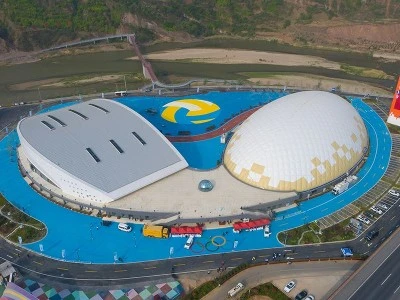
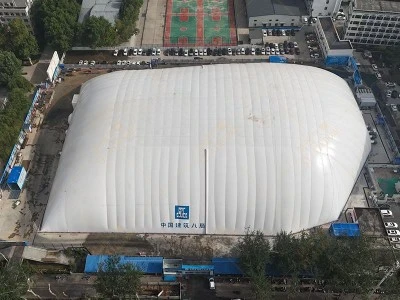
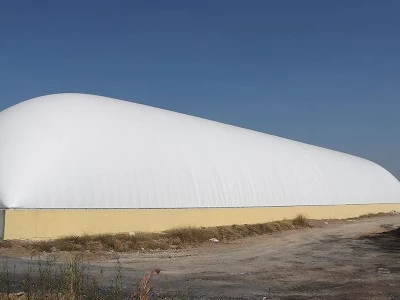
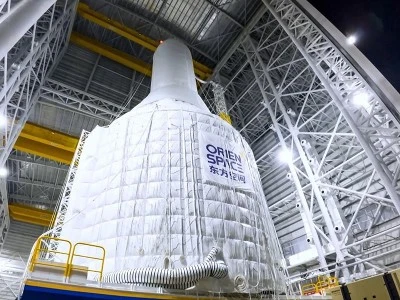
The environmental performance of agricultural air-supported membranes (or "air-supported structures") is primarily reflected in the safety of their materials, resource efficiency, energy conservation and thermal insulation, and the recycling or disposal of waste materials. In agricultural production, these membranes are commonly used for greenhouses, seedling-rearing facilities, livestock and poultry housing, and large-scale inflatable agricultural structures. Their environmental impact is determined not only by the composition of the membrane material itself but also by production processes, service life, and end-of-life disposal methods. Standard agricultural covering films are often made from materials such as polyethylene (PE) or ethylene-vinyl acetate (EVA) copolymers, which are lightweight, offer good light transmission, and are easy to process. By carefully selecting the appropriate film thickness, incorporating UV-stabilizing additives, and optimizing production techniques, it is possible to meet operational requirements while extending the service life of the film-thereby reducing material consumption caused by frequent replacements. In the case of double-layered inflatable insulation membranes, the air trapped between the layers provides thermal insulation, which helps reduce heat loss from greenhouses and can lower heating energy consumption under appropriate climatic and management conditions. Large-scale inflatable agricultural structures are lightweight and offer flexible construction methods, which can reduce the need for certain traditional building materials. However, the environmental impact of these membranes cannot be judged solely by whether the material is thin or lightweight; one must also consider energy consumption during production, the use of additives, material durability, and the potential generation of debris or other pollutants during use. The goal is to meet agricultural production requirements while minimizing the impact on the surrounding environment.
Environmental management during the use and disposal phases of agricultural membranes is equally critical. When exposed for long periods to sunlight, wind, rain, and temperature fluctuations, these films may gradually age, become brittle, or crack. If they are not maintained properly or are discarded indiscriminately after use, they can leave behind plastic residues in farmland, which negatively affect soil health and future agricultural production. Therefore, in practical application, inspection and replacement schedules should be established based on the weather resistance of the membrane material and the specific operating environment. Damaged membranes should be collected for recycling, and the direct burial or incineration of waste film must be avoided. For recyclable materials such as polyethylene, efforts should be made to ensure proper sorting and collection, followed by processing through recycling enterprises equipped with the necessary capabilities. In the case of agricultural films featuring multi-layer composite structures, coatings, or a combination of different polymers, the feasibility of recycling must be assessed based on their specific material composition; such composite films cannot simply be assumed to be directly recyclable. Furthermore, during the production and use of agricultural films, careful consideration must be given to their compatibility with crops, irrigation water, and the cultivation environment, ensuring that no materials or additives that fail to meet relevant standards are employed. For applications requiring long-term coverage, one should evaluate factors such as the service life, maintenance costs, thermal insulation performance, and recyclability of various film materials to select products with the lowest overall environmental impact throughout their entire life cycle. In summary, the environmental performance of agricultural films hinges on several stages-including material selection, energy-saving efficiency, operational management, and end-of-life recycling. Only by establishing a comprehensive management mechanism that spans the entire process-from production and usage to recycling and disposal-can these films effectively contribute to energy conservation and environmental protection in modern agriculture.