

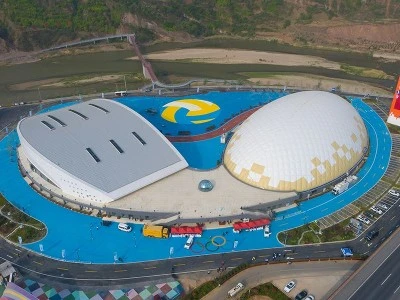
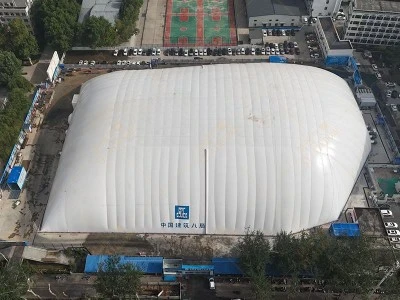
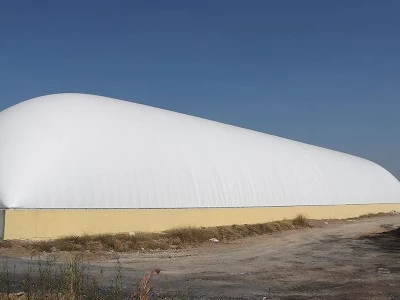
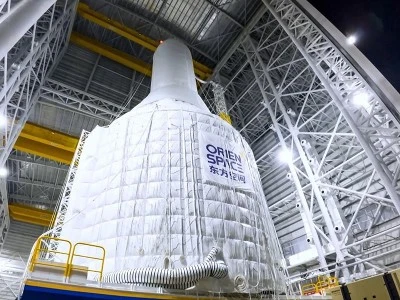
An air-supported enclosure for foundation pits is an inflatable, sealed containment structure used during the construction phase of building foundation pits. It creates a relatively enclosed workspace through the use of high-strength flexible membrane materials, an air-supply system, and supporting anchorage components. Compared to traditional open-pit construction, these air-supported enclosures provide a continuous cover over or around the pit, which helps contain construction dust, mitigates the impact of noise on the surrounding environment, and offers a relatively stable environment for tasks such as earth excavation, steel reinforcement processing, and concrete work. Structurally, these enclosures typically utilize a composite membrane-consisting of a high-strength fiber-based fabric with a polymer coating-characterized by its low self-weight, high flexibility, and extensive coverage capacity. The membrane maintains its intended shape through air pressure supplied by fans, while loads are transferred to the foundation via anchoring devices and edge connectors. Given that foundation pit construction sites often involve large spans, numerous pieces of heavy equipment, and dynamic construction schedules, the design of such enclosures must account for factors including the required coverage area, internal clearance, equipment access, construction logistics, and site-specific geological conditions. Furthermore, structural calculations must be performed based on local wind loads, snow loads, and other environmental variables. Compared to traditional steel-framed enclosures, air-supported systems offer advantages such as flexible installation methods, fewer on-site components, and ease of assembly and disassembly. However, the overall safety of the system depends critically on the performance of the membrane material, the reliability of the anchorage, and the stable operation of the air-supply system; the lightweight nature of the membrane alone is not an indicator of its overall structural safety.
Another fundamental characteristic of these air-supported enclosures is their strong capacity for environmental isolation and their ability to regulate the construction environment. Through the strategic design of the membrane envelope, access points, and ventilation systems, the dispersion of dust can be minimized. Additionally, by integrating equipment for water spraying, dust collection, air purification, and noise control, the environmental management conditions within the enclosed construction zone can be significantly improved. During winter construction, an enclosed space helps mitigate the direct impact of cold winds and allows for the integration of compliant heating equipment to improve the working environment. In summer or high-temperature conditions, it is essential to enhance ventilation and cooling, while also monitoring air quality to prevent the buildup of internal heat and the accumulation of hazardous gases. Given that excavation pits may contain heavy machinery, transport vehicles, and other construction equipment, the air-supported membrane system must incorporate designated access paths for transport, entry and exit points for personnel, and emergency evacuation routes to ensure that the enclosure does not hinder routine operations or emergency egress. Throughout the operational phase, the condition of the membrane, internal pressure, fan performance, and anchorage connections must be continuously monitored, with appropriate safety measures implemented in response to changing weather conditions. In particular, during high winds, heavy snowfall, or intense rainfall, inspections and risk assessments must be conducted in accordance with design specifications to prevent structural damage caused by excessive wind loads, the accumulation of snow or water, or inadequate drainage. Furthermore, an air-supported membrane system for an excavation pit cannot serve as a substitute for essential measures such as pit shoring, slope stabilization, groundwater control, or general construction safety protocols; the membrane structure must be integrated into the overall safety management framework for the excavation project. In summary, air-supported membrane systems offer advantages such as extensive coverage, effective enclosure, and flexible deployment, making them well-suited for projects requiring dust control, noise management, or specific environmental conditions. However, their actual performance remains contingent upon the quality of structural design, on-site installation, operational management, and ongoing maintenance.