

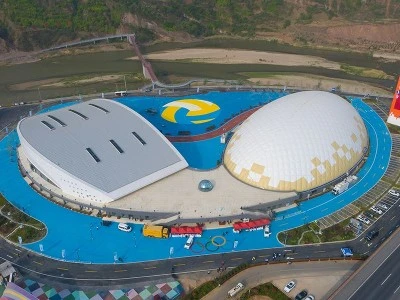
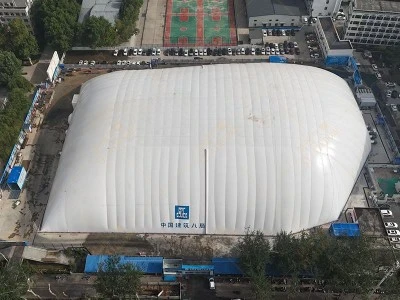
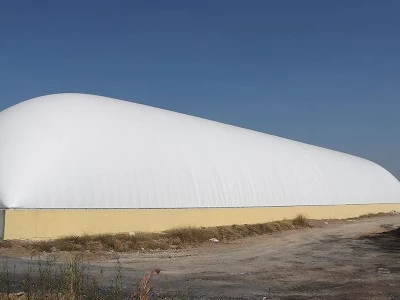
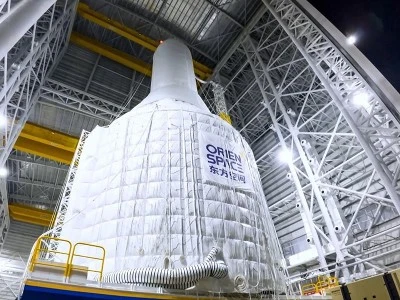
The technological development of air-supported structures for foundation pits focuses primarily on structural safety, intelligent control, environmental management, and construction efficiency. In the past, dust and noise control during foundation pit excavation typically relied on measures such as perimeter fencing, covering exposed soil, and installing localized dust-proof sheds. However, these methods often failed to provide a fully enclosed environment across the entire construction site, and their effectiveness was frequently compromised by specific construction sequences or site conditions. With the growing emphasis on "green construction," air-supported structures are increasingly being deployed for deep foundation excavation, ground improvement, and underground structural work. By utilizing high-strength flexible membrane materials, robust anchoring systems, and intelligent air-supply equipment, these structures create large-span, enclosed workspaces that effectively contain dust and noise, preventing them from spreading to the surrounding environment.
In terms of structural engineering, the industry has placed greater focus on the integrated design of membrane strength, overall load-bearing capacity, anchoring nodes, and edge sealing. System stability is enhanced through structural calculations, finite element analysis, and on-site testing. For foundation pits with irregular shapes, large spans, or complex surrounding environments, the layout of the membrane and its connection methods are optimized based on specific site conditions-overcoming the limitations of traditional construction sheds regarding space utilization, component arrangement, and installation speed.
Driven by advancements in intelligent construction and green building practices, air-supported structures for foundation pits are evolving toward intelligent control, comprehensive environmental management, adaptability to complex geometries, and modular, reusable configurations. While traditional air-supported systems relied primarily on fans to maintain internal pressure, a new generation of systems now incorporates pressure sensors, temperature and humidity monitoring, air quality detection, and automated control equipment. These systems provide real-time monitoring of the internal environment and equipment status, automatically adjusting airflow and operational parameters based on site conditions to enhance stability and minimize unnecessary energy consumption. Ongoing research is exploring intelligent monitoring and adaptive adjustment technologies-leveraging structural load analysis, optimized connection nodes, and dynamic control-to ensure that these air-supported structures can effectively adapt to the evolving demands of personnel, equipment, and environmental conditions throughout the construction process.