

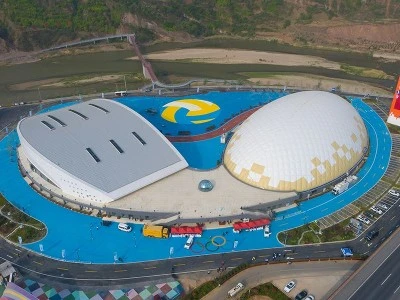
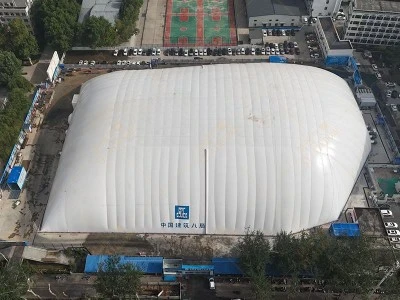
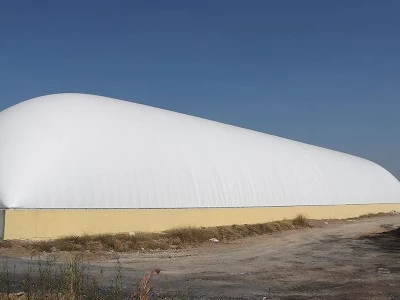
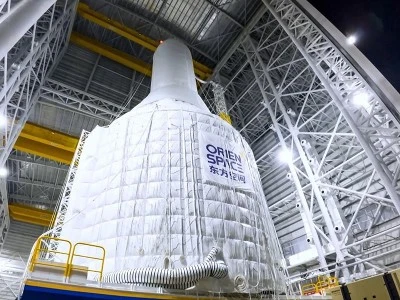
An air-supported membrane enclosure for foundation pits is a construction containment technology that integrates a flexible membrane structure with a mechanical air-supply system. Its technical characteristics encompass membrane fabrication, overall installation, air-pressure control, and adaptation to site-specific conditions. The primary membrane structure is typically composed of a high-strength fiber-based fabric with a polymer coating. During production, the design is refined based on the pit's dimensions (plan area, span, and height) and specific site conditions; the material is then processed-through cutting, heat sealing, welding, and localized reinforcement-into the required membrane units. Compared to traditional steel-structured enclosures, air-supported membranes are lightweight and require fewer rigid components, thereby reducing the need for transporting and hoisting large structural elements. This makes them particularly well-suited for projects with tight construction schedules, restricted site space, or a need for the rapid creation of an enclosed workspace. Installation involves preparing the foundation, positioning anchor components, and connecting the membrane units, followed by unfolding, securing, and calibrating the air-supply system to ensure that all connection points are properly loaded and the membrane surface achieves the required tension. For large-span enclosures, precise control over membrane cutting dimensions, seam quality, edge securing, and anchorage is critical to prevent issues such as localized slack, insecure connections, or uneven stress distribution, which could compromise the stability of the entire structure. Once in operation, the system relies on dedicated blowers to maintain a specified internal pressure, creating a stable, enclosed environment. Consequently, the selection of blowers, the layout of air ducts, pressure monitoring, and the provision of backup power are essential components of the technical design-this process should not be misconstrued as a simple, basic membrane covering.
Another key technical feature of air-supported membrane enclosures in practice is their ability to integrate with systems for dust control, ventilation, and environmental monitoring, effectively combining enclosed construction with comprehensive on-site environmental management. Once the air-supported membrane structure is installed, personnel access points, vehicle entry/exit points, equipment maintenance openings, and emergency evacuation routes can be strategically arranged to accommodate various construction activities-such as excavation, vehicle transport, steel reinforcement processing, and the construction of underground structures. These measures should be integrated with dust-suppression sprinkler systems, air filtration, and mechanical ventilation to minimize the outward spread of dust and mitigate the impact of construction noise on the surrounding environment. Given that the interior of the air-supported structure is a relatively enclosed space, careful attention must be paid to air circulation, temperature fluctuations, and exhaust gases generated by machinery; environmental control cannot rely solely on the enclosure itself. Operational management should include continuous pressure monitoring and regular equipment inspections to track the status of the membrane and the air-supply system. This entails periodic checks of membrane seams, anchorage connections, fan performance, and electrical control systems, with prompt action taken in the event of air leaks, membrane damage, or abnormal pressure. In the face of severe weather-such as high winds, heavy rain, or snowfall-specialized inspections must be conducted in accordance with structural design requirements, and pre-established emergency protocols should be activated to protect the structure from adverse impacts. From the perspective of construction organization, air-supported membranes offer potential for dismantling and reuse; however, the feasibility of reuse depends on factors such as the degree of wear on the membrane material, the condition of the seams, the methods used for dismantling and reassembly, and the results of subsequent inspections. In practice, projects should be tailored to specific site conditions-including excavation dimensions, geological characteristics, construction schedules, and local climate-by integrating structural installation, equipment commissioning, environmental control, and ongoing maintenance into a unified management framework. This approach ensures that the full advantages of air-supported structures-namely rapid installation, extensive coverage, and effective environmental isolation-are effectively realized.