

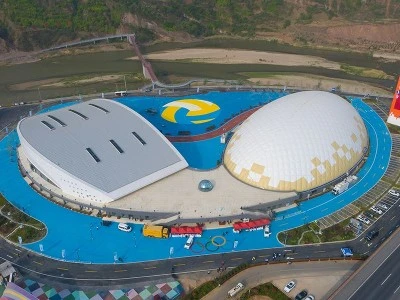
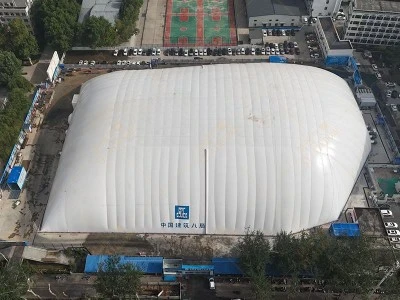
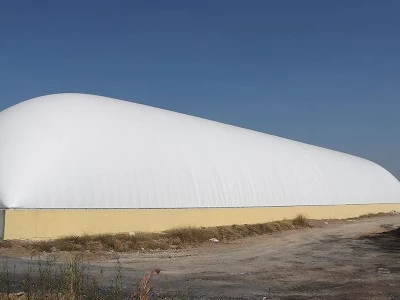
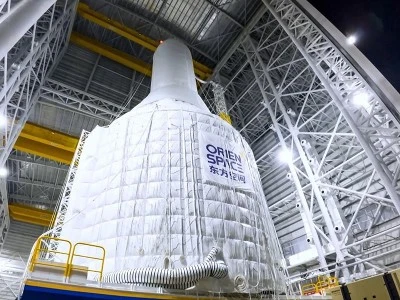
Air-supported enclosures for foundation pits are primarily designed for urban construction projects-such as underground space development, metro line construction, and municipal infrastructure-where the excavation site requires full enclosure. They are particularly well-suited for projects in environmentally sensitive areas with strict requirements for dust and noise control. In city centers, near residential zones, around commercial buildings, or in high-traffic areas, activities like excavation, earthwork transport, and the operation of heavy machinery often generate significant dust and noise. While traditional construction hoarding may fail to provide a complete seal, air-supported enclosures-constructed using high-strength, flexible membrane materials and supported by an air-supply system-create a relatively isolated workspace. This effectively contains dust and helps mitigate the impact of construction noise on the surrounding environment. These systems are also ideal for long-term projects involving continuous excavation or the construction of underground structures; they can be custom-designed to accommodate specific pit dimensions, equipment access requirements, and necessary vertical clearance. In regions prone to extreme temperatures (very cold winters or hot summers) or adverse weather, these enclosed spaces can be integrated with ventilation, cooling, or heating equipment to improve working conditions and minimize the impact of external weather fluctuations on construction progress. It should be noted, however, that the enclosure itself does not automatically regulate all environmental variables; its actual performance depends on the integrity of the seal, the effectiveness of the ventilation strategy, the adequacy of the equipment, and the quality of on-site operational management.
The applicability of air-supported enclosures is constrained by factors such as local climatic conditions, available site space, structural safety, and specific construction methods; therefore, a comprehensive assessment is required before implementation. In areas prone to high winds, heavy snowfall, or frequent extreme weather, the membrane material, anchoring system, foundation connections, and overall structure must be engineered to meet local design load requirements. Furthermore, specific inspection protocols and emergency response plans must be established for scenarios involving high winds, blizzards, or heavy rainfall. If the site involves large-scale lifting equipment, tall earth-moving vehicles, or complex hoisting operations, it is essential to verify that the internal vertical clearance, the operational range of machinery, and the transport corridors meet all necessary requirements. For projects where vehicle exhaust, machinery emissions, or other hazardous gases may accumulate within the pit, appropriate ventilation systems must be installed. Additionally, gas monitoring and alarm systems should be implemented based on identified risks to prevent the buildup of pollutants within the enclosed space. In addition, the site must provide adequate foundation anchoring conditions, sufficient space for equipment installation, a reliable power supply, and emergency evacuation routes. If the excavation pit has an irregular shape, is surrounded by numerous obstacles, or involves frequently changing construction sequences, targeted planning must be carried out during the design phase. It is crucial to note that an air-supported membrane structure for an excavation pit serves primarily as an enclosure for environmental control; it cannot replace structural shoring, slope stabilization, groundwater control, or other mandatory safety measures. When selecting such a system, one must comprehensively evaluate factors including the local climate, the scale of the excavation, the surrounding environment, construction logistics, and operational costs-ensuring that the structural design and auxiliary systems meet all project requirements before the structure is put into use.