

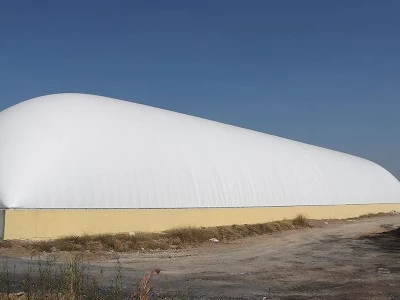
In agricultural production, air-supported membrane structures (agricultural air membranes) are primarily used in areas such as greenhouses, livestock and poultry farming, edible fungus cultivation, agricultural product storage, and the thermal insulation of agricultural facilities. By leveraging the light-transmitting, heat-retaining, waterproof, and isolation properties of membrane materials, these systems provide a relatively stable environment for crop growth and agricultural activities. In greenhouse cultivation, air membranes serve as enclosure materials; by precisely controlling factors like light transmission, material thickness, and thermal insulation, they optimize temperature and lighting conditions within the structure, mitigating the impact of external elements-such as low temperatures, wind, and precipitation-on crop development. Compared to traditional glass greenhouses, certain air-supported membrane structures offer advantages such as lower self-weight, larger coverage areas, and greater construction flexibility, making them well-suited for the large-scale cultivation of vegetables, flowers, seedlings, and various cash crops. In cold regions or during winter production, double-layered membrane structures can be employed; the air gap between the layers acts as an insulator, reducing heat loss from within the structure and lowering energy consumption for heating. In livestock and poultry farming, air-supported structures can be used to build large-scale housing facilities. Fans and air-pressure control systems maintain the shape of the membrane, while integrated ventilation, cooling, and heating equipment regulate the internal environment, ensuring a stable space for livestock operations. Furthermore, in applications such as edible fungus cultivation, seedling propagation, and the temporary storage of agricultural products, these membranes can be used for environmental isolation or as protective covers, helping to shield production processes from external environmental fluctuations. It is important to note, however, that the functions of different types of membranes vary significantly: standard agricultural plastic films are primarily used for covering and basic environmental adjustment, whereas air-supported membrane structures require additional supporting systems-such as air supply, pressure control, and structural anchoring-and should be selected based on the specific requirements of the agricultural facility.
As facility-based agriculture evolves toward greater scale, intelligence, and energy efficiency, the application of agricultural membrane structures is shifting from simple covering functions toward comprehensive environmental control and integrated management. In modern greenhouses, air-supported membrane structures can be integrated with temperature and humidity sensors, ventilation equipment, shading systems, irrigation devices, and automated control systems. This allows for the adjustment of the internal environment based on crop growth stages and external weather conditions, thereby enhancing both facility utilization and production management efficiency. For instance, during periods of high summer temperatures, the internal heat load can be reduced through ventilation, shading, and humidity management; in winter, heat loss can be minimized by employing double-layered membranes, thermal screens, and auxiliary heating equipment. In large-scale agricultural air-supported structures, the interior can be partitioned into distinct functional zones tailored to specific cultivation or livestock-rearing needs-accommodating tasks such as seedling propagation, production, sorting, and temporary storage. In practice, the effectiveness of these structures depends not only on the membrane material itself but also on local climatic conditions, the structural design of the facility, ventilation methods, and routine maintenance. When selecting an air-supported membrane, key factors to consider include light transmission, thermal insulation, wind resistance, aging resistance, and overall service life; furthermore, the structure must be verified against local wind and snow load requirements and the design standards for agricultural facilities. Additionally, after long-term use, the membrane surface should be regularly inspected for damage, aging, slackness, or compromised seals, with prompt attention given to issues such as the accumulation of water or snow, or irregularities at connection points. Overall, air-supported membrane structures offer a flexible solution for space coverage and environmental control in protected agriculture; however, their actual economic viability should be evaluated by holistically considering construction costs, energy consumption, the specific types of crops grown, and local climatic conditions.