

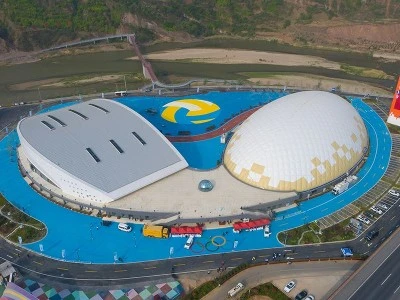
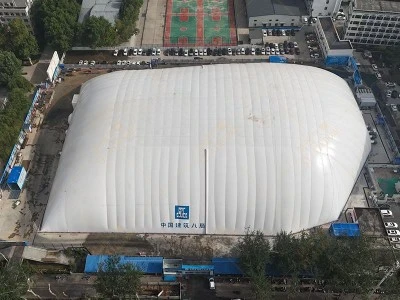
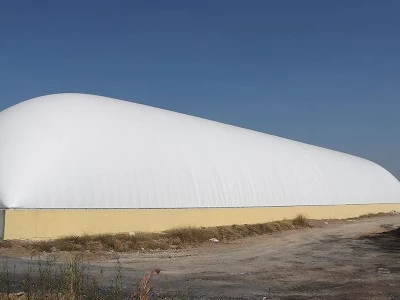
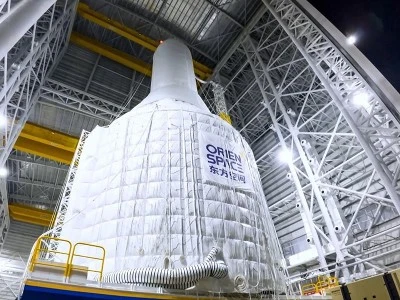
An air-supported enclosure for foundation pits is an inflatable, sealed containment system used at construction sites. It primarily consists of high-strength flexible membrane materials, an air supply system, anchoring structures, and auxiliary control equipment. By using fans to provide a continuous air supply or maintain a specific internal pressure, the membrane forms a stable, enclosed space, creating a relatively independent environment for activities such as excavation, earthwork transport, and the construction of underground structures. Compared to traditional open-air construction methods, these air-supported enclosures can cover large areas, effectively containing dust, mitigating construction noise, and providing protection against external factors like wind, rain, and low temperatures. The membrane material-typically a composite of high-strength fiber-based fabric and a polymer coating-is lightweight, flexible, capable of spanning large distances, and relatively easy to assemble and disassemble. Depending on project requirements and structural design, these enclosures can be configured as air-supported (pressure-stabilized), air-ribbed (inflatable structural ribs), or other suitable membrane-based forms, tailored to the dimensions of the pit, the layout of construction equipment, personnel access needs, and site-specific environmental conditions. For large-scale projects, those located in environmentally sensitive areas, or sites with stringent dust-control requirements, these enclosures can be integrated with dust-suppression spray systems, air purification units, ventilation systems, and environmental monitoring equipment to enhance the level of enclosed management at the construction site.
As requirements for "green construction" and environmental management in the building industry continue to rise, air-supported enclosures are increasingly being adopted as auxiliary facilities for large-scale foundation pit projects. Their value lies primarily in environmental protection, construction organization, and site management. In practice, these systems create a relatively sealed workspace that prevents construction dust from spreading to nearby roads and buildings, while also providing space for the installation of internal lighting, ventilation, and environmental control equipment. Compared to traditional, fixed steel-structure sheds, certain air-supported systems offer advantages such as fewer components, shorter installation times, and greater ease of relocation-making them well-suited for projects where construction phases evolve rapidly. However, an air-supported membrane structure for an excavation pit is more than just a simple covering; its stable operation relies on sound structural design, a reliable anchoring system, and a consistent, effective air supply. Design and construction must thoroughly account for factors such as the span of the excavation, wind and snow loads, stress on the membrane, foundation connections, and emergency evacuation. Furthermore, site-specific contingency plans for ventilation, fire safety, and extreme weather conditions must be established. It is crucial to note that such air-supported structures serve solely as a means of enclosure and environmental management during excavation; they cannot replace essential engineering safety measures, such as excavation support systems, slope stabilization, or groundwater control. In essence, an air-supported membrane for an excavation pit is an engineering application that integrates flexible membrane structures with mechanical ventilation and environmental control; its overall effectiveness depends on the quality of the design, on-site construction, operational maintenance, and the specific conditions of the project.