

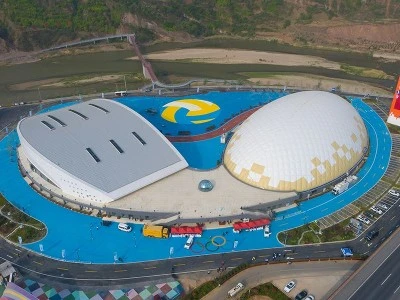
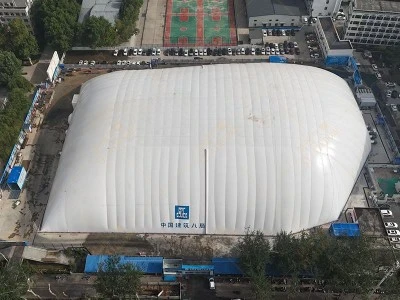
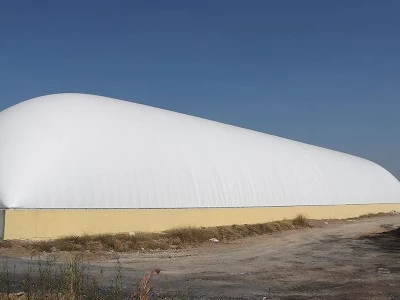
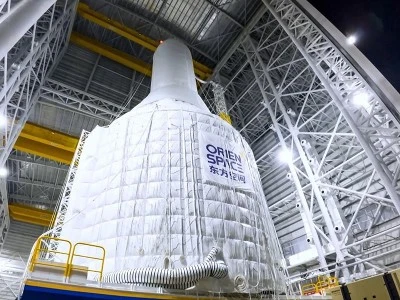
The future development of air-supported structures for excavation pits will increasingly focus on the comprehensive enhancement of structural safety, material performance, and the ability to manage the construction environment. As the scale of construction projects grows and regulations regarding dust, noise, and environmental impact become more stringent, these air-supported structures are evolving from simple enclosures into multifunctional construction environment management systems. In terms of structural design, these systems must adapt to the varying spans, depths, plan geometries, and site conditions of different excavation pits. Consequently, future designs will place greater emphasis on customization-optimizing membrane shapes, anchorage nodes, and edge connections to bolster overall structural stability and wind resistance. Simultaneously, membrane materials will continue to evolve toward higher strength, lower weight, and greater resistance to aging and temperature extremes. This will ensure durability during long-term outdoor use in complex weather conditions, while reducing costs associated with membrane damage, seam failure, and frequent replacements. In practice, these structures must be integrated seamlessly with earthwork transport, machinery operations, material hoisting, and personnel access to ensure that the enclosure does not hinder construction efficiency. Therefore, modular designs that facilitate rapid installation and easy dismantling will gain prominence, allowing the structures to be adjusted according to project progress, and subsequently removed, maintained, and reused elsewhere. For projects with large spans or complex surrounding environments, it is also essential to strengthen structural analysis, on-site monitoring, and safety assessments for extreme weather conditions, thereby enhancing the versatility of these systems across diverse construction scenarios.
The integration of intelligent control systems and green construction technologies will represent a key direction for the future of air-supported structures in excavation pits. Traditional systems rely primarily on blowers to maintain internal pressure, with daily operations often requiring manual inspections-a process whose efficiency can be heavily influenced by the experience of personnel and specific site conditions. Future systems may incorporate pressure sensors, automated blower controls, temperature and humidity monitors, and air quality detectors to provide real-time oversight of internal pressure, equipment status, and the construction environment. Such systems could trigger immediate alerts in the event of pressure anomalies, blower malfunctions, or environmental parameters exceeding safety thresholds, thereby significantly improving operational stability. Furthermore, air-supported membrane structures can be integrated with dust-suppression sprinkler systems, air purification units, ventilation equipment, and noise-monitoring devices. Their operational modes can be adjusted based on the specific construction phase and on-site pollution levels, thereby minimizing unnecessary energy consumption. In the context of "green construction," companies are increasingly focusing on the service life, repairability, and reusability of membrane materials. By refining seam-joining techniques, optimizing material selection, and establishing robust maintenance protocols, the total life-cycle cost of these facilities can be reduced. For large-scale excavation projects, the use of Building Information Modeling (BIM) and digital construction management platforms allows for the proactive planning of membrane installation locations, equipment layouts, construction access paths, and emergency evacuation routes-effectively mitigating conflicts between on-site installation and overall construction logistics. In summary, the development of air-supported membrane structures for excavation sites is shifting toward a synergistic focus on structural safety, intelligent operation and maintenance, environmental management, and resource recycling. However, specific technical solutions must be carefully tailored to the scale of the excavation, local climatic conditions, construction methods, and safety requirements, ensuring that while these membranes serve their environmental protection purpose, they do not compromise the safety or progress of the excavation work itself.